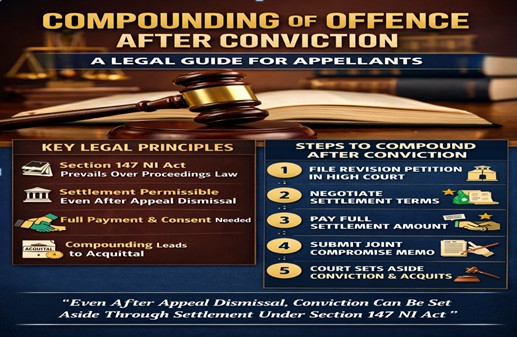
Compounding of Offence After Confirmation of Conviction: A Detailed Analysis of Post-Conviction Settlement under Section 147 NI Act
An Analysis of Balachenniappan v. Jeyakrishnan Madurai Bench of the Madras High Court (Crl.R.C.(MD) No. 875 of 2025, 19.09.2025)
1. Introduction
Cheque dishonour cases under Section 138 of the Negotiable Instruments Act, 1881 (NI Act) occupy a distinctive position in criminal jurisprudence. Although classified as a criminal offence, these cases are fundamentally rooted in commercial transactions and the enforcement of monetary liability. The primary objective is restitution rather than retribution.
2. Legal Question
Whether a conviction under Section 138 of the NI Act, once confirmed in appeal, can be set aside on the basis of a compromise arrived at during the pendency of a criminal revision petition?
In K. Balachenniappan v. Jeyakrishnan (Crl.R.C.(MD) No. 875 of 2025, decided on 19.09.2025, the Madurai Bench of the Madras High Court answered this question in the affirmative, providing significant clarity on the scope of compounding under Section 147 of the NI Act even at advanced stages of litigation.
3. Factual Background
The petitioner, K. Balachenniappan, was convicted by the learned District Munsif-cum-Judicial Magistrate, Peraiyur, in S.T.C. No. 643 of 2016 (judgment dated 20.04.2022) for an offence under Section 138 of the NI Act and sentenced to simple imprisonment for one year along with a fine. The conviction and sentence were confirmed by the Appellate Court (IV Additional District and Sessions Judge, Madurai) in C.A. No. 34 of 2022 (judgment dated 05.04.2025).
Aggrieved by the concurrent findings, the petitioner preferred a criminal revision before the High Court. During the pendency of the revision petition, the parties amicably settled the dispute. The petitioner had earlier deposited a substantial portion of the cheque amount and paid the remaining balance through a demand draft, resulting in full discharge of the liability (total settlement amount: ₹2,00,000). A Joint Memorandum of Compromise was executed on 18.09.2025, wherein the complainant unequivocally consented to the compounding of the offence under Section 147 of the NI Act and confirmed full satisfaction of his claims.
4. Statutory Framework
- Section 138 NI Act – Nature of the Offence Section 138 creates a penal liability for the dishonour of a cheque due to insufficiency of funds or for reasons referred to in the provision. However, the Supreme Court has consistently held that the offence is predominantly civil in character. In M/s. Meters and Instruments Private Limited v. Kanchan Mehta, the Apex Court observed that the provision is intended to serve as a mechanism for enforcement of civil liability through criminal sanctions, with the primary object being compensatory rather than retributive.
- Section 147 NI Act – Compounding of Offences Section 147 of the NI Act provides: “Notwithstanding anything contained in the Code of Criminal Procedure, every offence punishable under this Act shall be compoundable.” The non-obstante clause confers overriding effect, enabling compounding without being fettered by the general limitations under the procedural criminal law.
- Section 359 of the Bharatiya Nagarik Suraksha Sanhita, 2023 (BNSS) lays down the general framework for compounding of offences. It specifies:
- the categories of offences that may be compounded;
- the persons competent to compound the same;
- the requirement of court permission in certain cases;
- the legal effect of compounding (resulting in acquittal); and
- certain restrictions on compounding after conviction or at appellate/revisional stages.
The High Court held that the NI Act, being a special statute with a non-obstante clause, prevails over the general procedural provisions of the BNSS. Applying the doctrine generaliaspecialibus non derogant (a special law prevails over a general law).
The Court ruled that Section 147 of the NI Act is not constrained by the procedural rigours or post-conviction restrictions contained in Section 359 BNSS.
5. Judicial Reasoning
The Court reasoned as follows:
- Compensatory Nature of the Offence: Cases under Section 138 of the NI Act essentially involve disputes of a commercial and monetary nature. The complainant’s primary interest lies in recovery of the amount rather than the incarceration of the accused. The punitive element is merely incidental to ensuring compliance with the compensatory objective. This aligns with the Supreme Court’s observations in Damodar S. Prabhu v. Sayed Babalal H. and Vinay Devanna Nayak v. Ryot Seva Sahakari Bank Limited.
- No Bar Based on Stage of Proceedings: Compounding is permissible at any stage of the proceedings, including after the dismissal of the appeal and during the revisional jurisdiction of the High Court. The only prerequisites are a genuine settlement, full discharge of the monetary liability, and free consent of the complainant.
- Overriding Effect of Section 147: The non-obstante clause in Section 147 of the NI Act overrides contrary provisions in the BNSS. The High Court can exercise its revisional powers (or inherent jurisdiction under Section 482 CrPC / corresponding BNSS provision) to give effect to the compromise and set aside the conviction in order to secure the ends of justice.
The Court emphasised that denying compounding merely because the matter has reached the revisional stage would defeat the legislative intent behind the NI Act and the amendments introduced to promote the use of cheques as a reliable instrument of credit.
6. Procedural Roadmap for Post-Conviction Compounding
The judgment offers a practical framework for parties seeking compounding after conviction:
- Filing of Criminal Revision: After the appeal is dismissed, the accused may file a revision petition before the High Court challenging the concurrent findings.
- Seeking Interim Relief: The petitioner may seek suspension of the sentence, often coupled with a direction to deposit a portion of the cheque amount, to demonstrate bona fide intent.
- Negotiation and Settlement: Parties negotiate and arrive at a mutually acceptable settlement amount and payment schedule.
- Full Discharge of Liability: The accused must make complete payment of the settlement amount. Partial payment is generally insufficient for compounding.
- Execution of Joint Memorandum of Compromise: A detailed joint memo should be filed recording:
- the details of the conviction and appeal;
- the total settlement amount and confirmation of full payment;
- the complainant’s unequivocal consent to compound the offence under Section 147 of the NI Act; and
- a specific prayer for setting aside the conviction and acquittal of the accused.
- Judicial Approval: Upon satisfaction that the compromise is genuine and voluntary, the Court permits compounding, sets aside the conviction and sentence, and declares the accused as acquitted. Compounding under Section 147 has the legal effect of acquittal.
Conclusion
The decision in K. Balachenniappan v. Jeyakrishnan is a progressive ruling that reinforces the compensatory character of proceedings under Section 138 of the NI Act. It unequivocally holds that even after confirmation of conviction in appeal, parties are not precluded from compounding the offence under Section 147 of the NI Act at the revisional stage.
By prioritising restitution and commercial harmony over punishment, the judgment aligns the criminal justice process with the economic realities underlying cheque transactions. It provides much-needed procedural clarity and strengthens the legislative objective of encouraging amicable settlements in cheque dishonour cases, thereby reducing the burden on the judiciary while upholding the credibility of negotiable instruments.
This ruling will serve as an important precedent for legal practitioners and litigants navigating post-conviction settlements in NI Act matters.