Electronic Cigarettes in India: A Legal Note on PECA, 2019 (Online Sale, Possession, Travel, Customs and Corporate Liability)
This note examines the Prohibition of Electronic Cigarettes (Production, Manufacture, Import, Export, Transport, Sale, Distribution, Storage and Advertisement) Act, 2019 (Act No. 42 of 2019) (“PECA” or “the Act”) as it applies, in 2026, to online and social-media transactions, personal possession and use, inbound and outbound travel, proceedings under the Customs Act, 1962, and the liability of companies and persons in charge. It is intended as a statement of the statutory position and of the manner in which that position is being administered. It is not a brief for either liberalisation or further criminalisation.
Legislative Framework
A. Enactment and object
The Union Cabinet approved an Ordinance on 18 September 2019. Parliament enacted PECA as a permanent statute; it received Presidential assent and was notified on 5 December 2019, with retrospective operation from the date of the Ordinance. The long title records the object: prohibition of the production, manufacture, import, export, transport, sale, distribution, storage and advertisement of electronic cigarettes “in the interest of public health to protect the people from harm.” The legislative record relies on the Indian Council of Medical Research white paper of May 2019, the prior prohibition already adopted by sixteen States and one Union Territory, and Article 47 of the Constitution.
As on 22 September 2026, PECA has not been amended. In February 2026 the Ministry of Health and Family Welfare publicly stated that the Government was not considering revocation, amendment or relaxation of the ban, including in respect of heat-not-burn products. Enforcement remains with State and Union Territory police, authorised officers under the Act, and, at the border, the customs apparatus under the Customs Act, 1962.
B. Definition Section 3(d)
Section 3(d) defines “electronic cigarette” as:
“an electronic device that heats a substance, with or without nicotine and flavours, to create an aerosol for inhalation and includes all forms of Electronic Nicotine Delivery Systems, Heat Not Burn Products, e-Hookah and the like devices, by whatever name called and whatever shape, size or form it may have, but does not include any product licensed under the Drugs and Cosmetics Act, 1940.”
Three consequences follow on a plain reading.
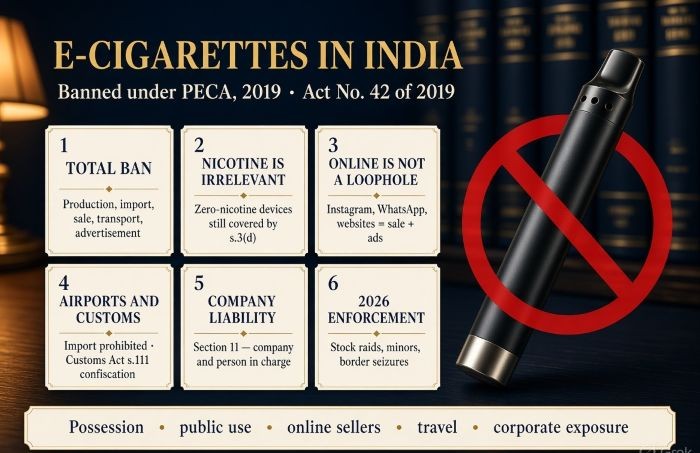
- Nicotine is not the touchstone. The phrase “with or without nicotine and flavours” brings zero-nicotine devices within the prohibition if they heat a substance to produce an inhalable aerosol. A representation that the liquid is “0 mg”, “herbal” or “nicotine-free” is not a statutory defence.
- Form is irrelevant. Disposable pens, pod systems, mods, heat-not-burn sticks and e-hookahs are covered by the inclusive limb, regardless of brand name or appearance.
- The only exclusion is a Drugs and Cosmetics licence. Nicotine replacement therapies (gums, patches) that hold a licence under the Drugs and Cosmetics Act, 1940 stand outside PECA. No consumer electronic cigarette on the Indian grey market presently holds that licence. Tobacco-free nicotine pouches are not “electronic cigarettes” for want of a heating device; they raise a separate question under the drugs legislation and are not analysed here.
C. The operative Prohibitions Sections 4 and 5
Section 4. On and from commencement, no person shall, directly or indirectly (i) produce, manufacture, import, export, transport, sell or distribute electronic cigarettes, whether as a complete product or any part thereof; and (ii) advertise electronic cigarettes or take part in any advertisement that directly or indirectly promotes their use.
The section is drafted at two levels of width. First, “directly or indirectly” and “any part thereof” pull in components (coils, pods, batteries, e-liquid) and intermediaries. Second, advertisement is an independent offence, not a mere aggravation of sale. “Person” is defined inclusively in Section 3 to cover an individual, a firm whether registered or not, a Hindu Undivided Family, a trust, an LLP, a co-operative society and a company.
Section 5. No person being the owner or occupier, or having the control or use, of any place shall knowingly permit that place to be used for storage of any stock of electronic cigarettes. The proviso required existing commercial stock as on commencement to be declared and deposited with the authorised officer. Section 5 is aimed at stock, not at the theoretical presence of a single device in a private dwelling; the word used is “stock.” That textual distinction matters when one turns to personal possession.
D. Search, cognizance and punishment Sections 6, 7, 8, 12 and 13
Section 6 empowers an authorised officer who has reason to believe that the Act is being contravened to enter and search, without warrant, any place where trade in electronic cigarettes is carried on, or where they are produced, supplied, distributed, stored or transported, or where they are advertised. He may seize records and property reasonably suspected of connection with the offence, attach what cannot conveniently be seized, and produce a suspect before a Judicial Magistrate of the First Class. Searches follow the Code of Criminal Procedure, 1973 / the Bharatiya Nagarik Suraksha Sanhita, 2023. An authorised officer includes a police officer not below the rank of Sub-Inspector once notified by the Central or State Government.
Section 12 is the jurisdictional brake: no court shall take cognizance of an offence under the Act except upon a written complaint by an authorised officer. Section 13 makes the Section 4 offence cognizable.
Penalties under Sections 7 and 8
| Offence | First offence | Subsequent offence |
| Section 4 (manufacture, import, export, transport, sale, distribution, advertisement) | Imprisonment up to 1 year, or fine up to ₹1,00,000, or both | Imprisonment up to 3 years and fine up to ₹5,00,000 (cumulative) |
| Section 5 (permitting a place to be used for storage of stock) | Imprisonment up to 6 months, or fine up to ₹50,000, or both | No separate enhanced tariff is prescribed in the same structured form |
Personal Possession and Use: Statute and Administrative Construction
PECA does not contain a section that, in terms, criminalises the act of inhaling vapour or the mere carrying of a single device for personal consumption. The operative verbs in Section 4 are produce, manufacture, import, export, transport, sell, distribute and advertise. Section 5 speaks of “stock.” That drafting choice is why a number of practitioners, including in commentary surrounding the 2025 controversy over on-screen depiction of a vape, have said that if Parliament had intended to punish use it could have said so.
In October 2023 the Ministry of Health and Family Welfare addressed a clarification to the Ministry of Civil Aviation. The Ministry accepted that the Act does not expressly prohibit individual use, but reasoned that possession of an electronic cigarette within the country, in any form, quantity or manner, is not possible without a prior contravention of PECA. Dr Pulkesh Kumar, then Deputy Secretary, formulated the official line: possession “is in violation of” the Act. The same communication was intended to harden airport enforcement. A public reporting portal (violation-reporting.in) was notified around the same period.
The clarification is an administrative construction. It is not an amendment of Sections 4 or 5. It binds the officers to whom it is addressed as a matter of internal discipline; it does not, of itself, insert a new offence into the statute. Until Parliament amends the Act, or a High Court or the Supreme Court writes a binding paragraph on the point, two propositions coexist:
- On the text, PECA is a supply-chain statute.
- In administration particularly at airports, educational campuses and in raids following a complaint -possession is treated as evidence that a prohibited act (import, transport, purchase from an unlawful seller) has already occurred, and the device is seized.
The Cigarettes and Other Tobacco Products Act, 2003 (“COTPA”) does not neatly cover vaping. COTPA was written for smoked tobacco. Its public-place smoking ban and its on-screen health-warning code therefore apply to electronic cigarettes only by strained analogy. Police action against public vaping is, in practice, founded on PECA possession-as-contravention, on institutional rules (college, employer, stadium), or on general public-order powers - not on a clean COTPA charge.
Private use inside a dwelling remains the lowest-friction setting. Section 5 requires knowledge that a place is being used for storage of stock. One device for personal consumption is difficult to characterise as “stock.” The 2023 clarification nonetheless leaves a residual risk if officers are already lawfully on the premises for another purpose.
Online and Social-Media Transactions
Section 4 does not distinguish a physical counter from an Instagram handle, a WhatsApp catalogue or a cash-on-delivery website. Sale, distribution, transport and advertisement are the same offences on either channel.
A. The seller and the advertiser
A person who solicits orders, accepts payment and causes devices or parts to be delivered commits sale and distribution. A person who posts a reel, a story, a price list or a “stock tonight” broadcast takes part in an advertisement that promotes use. Both limbs of Section 4 are attracted. The first-offence tariff in Section 7 applies; the offence is cognizable; search without warrant under Section 6 is available against the place from which the trade is run, including a residence used as a dark store.
Where the purchaser is a child, Section 77 of the Juvenile Justice (Care and Protection of Children) Act, 2015 is available in addition to PECA. In September 2026 the Telangana EAGLE Force, acting on a social-media complaint, traced devices recovered from boys aged 15 to 17 to two adult suppliers and to named cash-on-delivery websites. The case was registered under Section 4 read with Section 7 of PECA and Section 77 of the Juvenile Justice Act. That combination PECA plus a child-protection statute is the filing that most reliably moves a police station.
B. The buyer
The Act does not create a named offence of “purchase.” The buyer’s exposure is derivative. Payment and doorstep delivery are the means by which import, transport and distribution are completed. The 2023 ministerial construction treats the resulting possession as itself a contravention. In the field, first-time buyers of a single device are more often met with seizure than with a Section 7 charge-sheet. That is an observed enforcement pattern. It is not a defence written into the statute, and it is not a representation on which a commercial buyer can rely.
C. Intermediaries
Platform terms already classify electronic cigarettes as restricted goods. That classification has not emptied the channel; it has only made handles fungible. A hosting or payments intermediary that continues a notified trade after specific notice invites a knowledge-based argument under Section 4 (“directly or indirectly”) and, where a company is in the chain, under Section 11. Those cases remain fact-intensive. They are no longer theoretical.
Travel, Aviation and Customs
A. Import and export under PECA
Both import and export are named in Section 4. There is no passenger, personal-use or de minimis exception in the Act. A device in cabin baggage, checked baggage or a duty-free bag is, on arrival into India, an import. A device taken out of India is an export. “I bought it lawfully abroad,” “it was sealed,” and “it was for my own use” are not statutory exceptions.
B. The Customs Act, 1962
Independently of PECA, electronic cigarettes are prohibited goods. The provision ordinarily invoked on the seizure memo is Section 111(d) of the Customs Act, 1962 (goods imported contrary to a prohibition). Absolute confiscation is the ordinary consequence for prohibited goods. Concealment, mis-declaration and commercial quantity convert a confiscation into an investigation against the importer, the overseas supplier and the person who signed the bill of entry.
Illustrative dockets from 2025–26, which show the pattern rather than exhaust it:
- June 2025, Coimbatore airport — passenger arriving from Abu Dhabi; commercial quantity of electronic cigarettes together with cigarettes and electronics; detention under PECA and the Customs Act.
- July 2025, Chennai Foreign Post Office — parcels from Malaysia declared as hangers and textiles; 998 electronic cigarettes recovered.
- January 2026, NSCBI Airport, Kolkata — passenger arriving from Kuala Lumpur; 640 pieces of identified disposable brands in checked baggage; Order-in-Original directing absolute confiscation under Section 111, value recorded at approximately ₹13.90 lakh.
- May 2026, Directorate of Revenue Intelligence — nearly 3,00,000 devices across Maharashtra, Gujarat, Delhi and West Bengal, valued above ₹120 crore; China origin; concealment in furniture and metal parts.
- July 2026, Jawaharlal Nehru Custom House, Nhava Sheva — approximately 1.16 lakh devices, valued at about ₹92.80 crore, Elfbar Moon Night 40K series, concealed in containers declared as furniture.
A single device in a toiletry pouch is typically met with seizure, a recorded statement and release of the passenger. Quantity, concealment and a commercial invoice are what convert the same facts into a prosecution file. Seized goods are not returned against payment of a composition at the belt; they follow the criminal-procedure disposal track.
C. Aviation safety rules are a separate layer
Lithium-battery rules issued by the Directorate General of Civil Aviation and the Bureau of Civil Aviation Security govern where a battery-powered device may sit on an aircraft (cabin rather than hold, device switched off, no use on board). Those rules exist because of fire risk. They do not authorise the carriage of a product that PECA has prohibited. The two regimes operate together. The 2023 Health Ministry note was sent to Civil Aviation precisely so that airport officers would apply a single construction of PECA.
On domestic sectors, “transport” in Section 4 is available in terms. In practice, CISF and airport security treat a single device as they treat campus security: seizure unless the bag resembles inventory. Airports, government buildings and examination centres remain high-friction locations.
Offences by Companies Section 11
Section 11 follows the Indian template for corporate criminal liability.
Section 11(1). Where an offence is committed by a company, every person who, at the time of the offence, was in charge of and responsible to the company for the conduct of its business, as well as the company itself, is deemed guilty. “Company” includes a firm and any association of individuals. The proviso supplies a defence: the person is not liable if he proves that the offence was committed without his knowledge, or that he had exercised all due diligence to prevent it. The burden of that defence is on the accused.
Section 11(2). Independently of sub-section (1), if the offence is proved to have been committed with the consent or connivance of, or to be attributable to any neglect on the part of, any director, manager, secretary or other officer, that officer is also deemed guilty. “Director,” in relation to a firm, means a partner.
The provision is engaged wherever the seller is more than an unincorporated individual: a private limited company or LLP operating a “lifestyle” retail front with a drawer of pods; a person who conducts an Instagram trade through a firm; a director who continues after notice that the same warehouse has been raided. Due diligence is a matter of contemporaneous systems written prohibition, stock checks, takedown of listings not of a press note issued after the seizure. A logistics or payments company that persists after specific notice is in a knowledge case under both Section 4 and Section 11.
The Enforcement Picture in 2025–26
Parliament has not rewritten PECA. What has changed is the identity of the files that are being registered.
- Stock, not a single puff. September 2026, Park Street, Kolkata four persons arrested for stocking and sale. September 2026, Fatehabad FIR against a music-shop keeper. Late 2025, Pune successive raids on gift and “smoke shop” premises under PECA and COTPA. December 2025, Vadodara — 487 boxes seized from a flat, value recorded above ₹10 lakh. These are Section 4 and Section 5 cases.
- Supply to children. The Hyderabad EAGLE Force matter of September 2026, noticed above, is the template: a public complaint, identification of minors, and a PECA-plus-Juvenile Justice charge against the adult source and the websites.
- The border as a commodity beat. DRI and Customs now treat China-origin disposable bricks as a smuggling commodity. Concealment inside furniture is a documented modus operandi. The 2023 Civil Aviation clarification has produced a consistent confiscation practice at the major international airports.
- Public spectacle without a PECA charge-sheet. In April 2026 the captain of Rajasthan Royals was sanctioned under Article 2.21 of the IPL Code of Conduct (conduct bringing the game into disrepute) after being broadcast vaping in the dressing room a fine of 25 per cent of the match fee and one demerit point. That was a sporting penalty. It was not a prosecution under Section 7. The episode illustrates the gap the first note in this series described: the device is visible; the statute is in force; the two meet only sometimes.
- Narcotics overlay. In December 2025 the Minister of State for Home Affairs informed the Rajya Sabha that the Narcotics Control Bureau had not investigated any case of electronic cigarettes laced with narcotic substances, and that there was no proposal then to amend the Narcotic Drugs and Psychotropic Substances Act, 1985 on that account. PECA remains a stand-alone prohibition. It becomes an NDPS matter only if the contents themselves are a notified narcotic or psychotropic substance.
The honest operational summary is therefore this. Commercial quantity and supply to children are being charged. A single device remains, in most urban police stations, a seizure risk rather than a jail story except at the airport, where confiscation is routine. That disparity is a fact of administration. It is not a licence, and it will not survive a complaint that names a minor or a warehouse.
Conclusion
PECA, 2019 is a complete prohibition of the supply chain in electronic cigarettes, including parts, including nicotine-free devices, including online and social-media advertisement. Import and export are named offences; the Customs Act supplies an independent confiscation power at the border. Section 11 reaches the person in charge of a company and, on proof of consent, connivance or neglect, the director, manager or partner. Section 12 confines cognizance to a written complaint by an authorised officer; Section 6 gives that officer a warrantless search.
What the Act does not do, in terms, is create a stand-alone offence of personal use. What the administration has done since October 2023 is to treat possession as a contravention and to enforce that reading first at airports and then, selectively, against stockists and against those who sell to children. That is the law as written and the law as lived. Anyone advising a client in this field should keep the two sentences apart, and should not promise that the second will remain as forbearing as it has been in respect of a single device.
Disclaimer
This note is for general information. It is not legal advice on any pending investigation, seizure or prosecution. The construction of PECA, the Customs Act and allied statutes turns on the facts of each matter and on any determination that a competent court may hereafter make.