GST E-Invoicing Notices Above ₹5 Crore Turnover: Understanding the Law, Legal Consequences and Emerging Litigation Issues
Introduction
The Goods and Services Tax ("GST") regime is increasingly driven by technology and data analytics. With enhanced access to taxpayer data, GST authorities are now capable of identifying discrepancies between turnover disclosed in returns and compliance obligations applicable to registered persons.
One area that has recently witnessed heightened scrutiny is compliance with the e-invoicing framework under the Central Goods and Services Tax Act, 2017 ("CGST Act") and the Central Goods and Services Tax Rules, 2017 ("CGST Rules"). Across the country, businesses are receiving verification notices seeking explanations for the alleged failure to generate e-invoices despite having crossed the prescribed turnover threshold.
While many taxpayers focus primarily on payment of GST and timely filing of returns, the consequences of non-compliance with e-invoicing provisions may extend beyond procedural concerns and raise important questions relating to invoice validity, input tax credit, and penalty exposure.
This article examines the legal framework governing e-invoicing, the reasons behind the recent verification drive, the consequences of non-compliance, and the key litigation issues that are likely to shape future GST jurisprudence.
The Growing Trend of E-Invoice Verification Notices
The GST administration has increasingly adopted technology-driven compliance mechanisms. Through integration of GST return data and Invoice Registration Portal ("IRP") records, authorities can identify taxpayers whose aggregate turnover exceeds the prescribed threshold but whose records do not reflect generation of Invoice Reference Numbers ("IRNs").
As a result, businesses across various sectors are receiving notices seeking information regarding:
- Aggregate turnover during relevant financial years;
- Applicability of e-invoicing provisions;
- Reasons for non-generation of e-invoices; and
- Details of transactions undertaken after e-invoicing became applicable.
Although such notices are generally issued for verification purposes, they have significant implications because they raise questions concerning compliance with Rule 48 of the CGST Rules and the validity of invoices issued without an IRN.
Statutory Framework Governing E-Invoicing
The legal architecture governing e-invoicing is derived from the CGST Act, the CGST Rules and various notifications issued by the Central Government from time to time.
Section 31 of the CGST Act, 2017
Section 31 mandates issuance of tax invoices in respect of taxable supplies of goods and services. The manner of issuance and particulars required to be contained therein are prescribed under the CGST Rules.
Section 2(6) of the CGST Act, 2017
Section 2(6) defines "aggregate turnover" and includes:
- Taxable supplies;
- Exempt supplies;
- Exports of goods or services; and
- Inter-State supplies,
computed on an all-India basis under the same Permanent Account Number (PAN), excluding taxes levied under GST laws.
Rule 48(4) of the CGST Rules, 2017
Rule 48(4) empowers the Government to notify classes of registered persons who are required to prepare invoices by uploading prescribed particulars on the Invoice Registration Portal and obtaining an Invoice Reference Number (IRN).
This provision forms the statutory foundation of the e-invoicing regime.
Rule 48(5) of the CGST Rules, 2017
Rule 48(5) provides that where Rule 48(4) applies, an invoice issued otherwise than in the prescribed manner shall not be treated as an invoice.
This provision lies at the centre of the ongoing debate concerning the legal consequences of non-generation of e-invoices.
Relevant Notifications
The e-invoicing regime has evolved through a series of notifications, including:
- Notification No. 13/2020-Central Tax dated 21 March 2020 introducing mandatory e-invoicing for specified classes of taxpayers;
- Notification No. 61/2020-Central Tax dated 30 July 2020 introducing consequential amendments;
- Notification No. 17/2022-Central Tax dated 1 August 2022 reducing the threshold from ₹20 crore to ₹10 crore; and
- Notification No. 10/2023-Central Tax dated 10 May 2023 reducing the threshold further to ₹5 crore with effect from 1 August 2023.
The reduction of the threshold to ₹5 crore significantly expanded the category of taxpayers required to comply with the e-invoicing framework.
Understanding the ₹5 Crore Threshold: A Common Misconception
One of the most common misconceptions among businesses is that e-invoicing becomes applicable only when the current year's turnover exceeds ₹5 crore.
The position is more nuanced.
For determining applicability of e-invoicing, the relevant notifications examine whether the aggregate turnover of the registered person has exceeded the prescribed threshold in any financial year from 2017-18 onwards. Consequently, a taxpayer who had crossed the threshold in an earlier financial year may continue to remain within the ambit of the e-invoicing regime notwithstanding a subsequent decline in turnover.
This aspect often goes unnoticed, particularly in the case of small and medium-sized enterprises whose turnover may fluctuate from year to year.
Aggregate Turnover Is Not the Same as Taxable Turnover
Another frequent area of confusion is the assumption that only taxable turnover is relevant while determining applicability of e-invoicing.
Section 2(6) of the CGST Act adopts a much broader concept of aggregate turnover and includes taxable supplies, exempt supplies, exports and inter-State supplies.
Consequently, businesses may inadvertently cross the prescribed threshold despite having taxable turnover below ₹5 crore.
Many taxpayers discover the applicability of e-invoicing only after receiving a verification notice from the department.
Which Transactions Require E-Invoicing?
Generally, e-invoicing applies to:
- Business-to-Business (B2B) supplies;
- Exports; and
- Supplies made to Special Economic Zones (SEZs).
Business-to-Consumer (B2C) transactions are generally outside the scope of mandatory e-invoicing.
This distinction assumes particular significance in sectors such as retail trade, garments, jewellery, electronics and consumer goods, where a substantial portion of turnover may arise from B2C transactions.
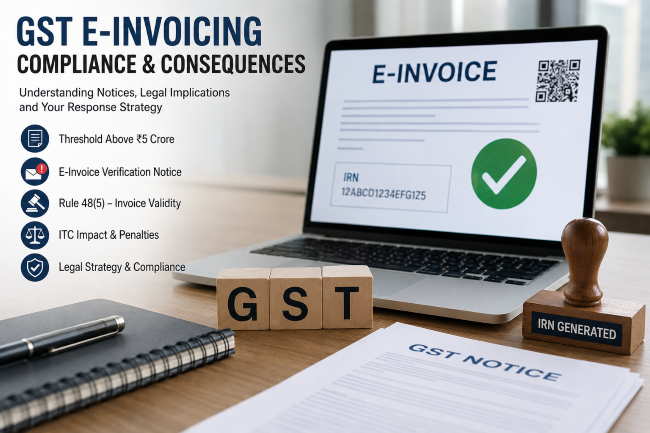
Can a Non-E-Invoice Become an Invalid Invoice?
Analysing Rule 48(5) and Its Practical Implications
The most significant legal issue arising from the e-invoicing framework is the interpretation of Rule 48(5).
The Rule provides that where Rule 48(4) applies, an invoice issued otherwise than in the prescribed manner shall not be treated as an invoice.
At first glance, the provision appears straightforward. However, its implications are far-reaching.
Consider a situation where goods have been supplied, consideration has been received, GST has been correctly charged and deposited, and the transaction has been duly disclosed in statutory returns. The only alleged lapse is the failure to generate an IRN.
Can such a transaction be treated as unsupported by a valid invoice?
Can a genuine commercial transaction become legally defective solely because of non-compliance with a procedural requirement?
These questions are increasingly becoming the focal point of disputes concerning e-invoicing compliance.
Can Rule 48(5) Override the Parent Statute?
The controversy surrounding Rule 48(5) also raises an important jurisprudential issue.
Section 31 of the CGST Act requires issuance of a tax invoice. Rule 48(5), which is delegated legislation, prescribes consequences where e-invoicing requirements are not followed.
A question that may arise in future litigation is whether delegated legislation can effectively render an otherwise genuine tax-paid transaction invalid when the substantive requirements of supply, consideration and tax payment stand fulfilled.
While the legislative objective of e-invoicing is undoubtedly to enhance transparency and curb tax evasion, the proportionality of the consequences flowing from procedural non-compliance is likely to become a significant area of judicial scrutiny.
Consequences of Non-Compliance
The consequences of failure to comply with e-invoicing requirements extend beyond mere procedural irregularity.
Invoice Validity
The primary consequence flows from Rule 48(5), which provides that an invoice issued otherwise than in the prescribed manner shall not be treated as an invoice.
This has the potential to trigger disputes concerning the legal validity of invoices issued without generation of an IRN.
Input Tax Credit Implications
The implications of Rule 48(5) may also affect recipients claiming Input Tax Credit ("ITC").
Section 16 of the CGST Act governs entitlement to ITC and prescribes various conditions that must be fulfilled by the recipient.
A significant question that may arise is whether a recipient who has otherwise satisfied the conditions prescribed under Section 16(2) can be denied ITC solely because the supplier failed to generate an IRN.
The answer to this question is likely to have far-reaching implications for both suppliers and recipients.
Penalty Exposure
Failure to comply with e-invoicing requirements may also expose taxpayers to penalty proceedings.
Depending upon the facts and circumstances of each case, authorities may seek to invoke:
- Section 122 of the CGST Act dealing with specified offences and penalties; and
- Section 125 of the CGST Act prescribing a general penalty for contraventions where no separate penalty has been provided.
However, an important distinction must always be drawn between deliberate tax evasion and procedural non-compliance. Where transactions are genuine, taxes have been duly paid, and disclosures have been made in statutory returns, taxpayers may legitimately argue that the alleged lapse is procedural in nature and has not resulted in any loss to the revenue.
Practical Implications for Businesses
Consider the case of XYZ Traders, a wholesale garment dealer, which receives a verification notice alleging failure to generate e-invoices despite crossing the prescribed turnover threshold.
The receipt of such a notice does not automatically establish tax evasion or revenue loss. The first issue that requires examination is whether e-invoicing was actually applicable, having regard to the taxpayer's aggregate turnover, the nature of supplies undertaken, and the period for which compliance is alleged.
Equally important is an assessment of whether the transactions were genuine, whether GST was duly discharged, and whether the supplies were appropriately disclosed in statutory returns. These factors are likely to assume significance in determining the consequences of any alleged non-compliance.
Accordingly, taxpayers receiving such notices should undertake a careful factual and legal review before responding to the authorities, particularly where the dispute concerns procedural compliance rather than suppression of transactions or evasion of tax.
Emerging Litigation Issues
The increasing enforcement of e-invoicing provisions is likely to generate substantial litigation concerning the interpretation and consequences of Rule 48(4) and Rule 48(5) of the CGST Rules.
From the department's perspective, failure to generate e-invoices despite applicability of the statutory framework constitutes a contravention of the GST provisions and may attract penal consequences. However, several important legal questions concerning the extent of such consequences remain open for judicial consideration.
These issues include:
- Whether an invoice issued without generation of an IRN can be regarded as an invalid invoice for all purposes under the GST law;
- Whether Input Tax Credit can be denied to the recipient where the underlying transaction is genuine and tax has been duly discharged;
- The scope and interpretation of Rule 48(5) in the context of completed and tax-paid transactions;
- The extent to which procedural non-compliance can impact substantive rights and obligations under the GST framework;
- The interplay between Section 31 of the CGST Act and Rule 48(5) of the CGST Rules; and
- The nature and extent of penal consequences that may follow from non-compliance with e-invoicing requirements.
As departmental scrutiny in this area continues to increase, these issues are likely to assume considerable importance and may play a significant role in shaping the future jurisprudence relating to GST e-invoicing compliance.
Conclusion
The increasing issuance of e-invoice verification notices marks a transition from traditional GST enforcement to technology-driven compliance administration. While the statutory framework clearly mandates e-invoicing for eligible taxpayers, the legal consequences of non-compliance continue to raise important questions concerning the distinction between procedural defaults and substantive tax violations.
As authorities increasingly invoke Rule 48(5), disputes are likely to arise regarding invoice validity, entitlement to input tax credit, penalty exposure and the extent to which delegated legislation can affect genuine tax-paid transactions. The next phase of GST litigation may therefore focus not on the applicability of e-invoicing, but on the proportionality of the consequences flowing from its non-compliance.
For businesses receiving verification notices, the correct approach is not panic, but a careful legal and factual evaluation of the circumstances. In many cases, the outcome may ultimately depend not on whether there was a lapse in compliance, but on whether that lapse resulted in any substantive prejudice to the revenue.