Import, Export & Customs Compliance: The Legal Backbone of Modern Trade
Exploring The Growing Importance Of Customs Compliance, Trade Regulation, and Legal Strategy In Modern International Commerce
Import and Export: Not Just Business, But Everyday Life
When you switch on a light bulb, charge your phone, wear a pair of shoes, or fill petrol in your car you are, in all likelihood, participating in the chain of international trade. The crude oil that powers your vehicle, the semiconductors inside your mobile phone, the raw cotton used in your shirt, and the machinery that manufactured your appliances much of it has, at some point, crossed an international border and entered India as an import.
Conversely, the medicines that treat patients across Africa, the software solutions powering companies in the United States, the rice being consumed in Bangladesh, and the engineering components assembled in Germany many of these originate in India as exports.
Import and export are not abstract economic concepts confined to boardrooms and policy papers. They are the invisible threads that hold together the fabric of modern daily life. And yet, most people including many who actively participate in international trade remain largely unaware of the complex legal framework that governs this flow of goods across borders. At the heart of this framework lies Customs Law.
Over the last twenty-five years, India has witnessed exponential growth in cross-border trade due to globalization, technological advancement, e-commerce expansion, government initiatives such as “Make in India,” and increasing participation of Indian businesses in international supply chains. Goods now travel across multiple jurisdictions before reaching the end consumer, making customs laws one of the most important pillars governing commercial trade.
Key Sectors That Have Seen Significant Growth
Electronics and Technology: With the rapid digitalization of the Indian economy and the global surge in demand for consumer electronics, India’s import of electronic goods has risen exponentially. From mobile phones and laptops to semiconductors and printed circuit boards, electronics now constitute one of the largest categories of Indian imports.
Petroleum and Energy: Crude oil and petroleum products remain India’s single largest import category. As the country’s energy needs have grown with industrialization and urbanization, so has its dependence on international oil markets, making the import of petroleum both a commercial and a strategic matter.
Pharmaceuticals and Chemicals: India has established itself as the “pharmacy of the world,” exporting generic medicines to over 200 countries. This success has simultaneously created demand for Active Pharmaceutical Ingredients (APIs), primarily imported from China and other countries.
Machinery and Engineering Goods: Capital goods including industrial machinery, heavy equipment, and engineering components form a significant portion of India’s imports. India’s engineering goods exports have also grown substantially, particularly to markets in the United States, Europe, and the Middle East.
Textiles and Apparel: One of India’s oldest and most established export sectors, textiles continue to contribute significantly to India’s foreign exchange earnings, with the European Union, the United States, and Southeast Asia being key markets.
Agricultural Commodities: India is among the world’s largest exporters of rice, spices, fresh produce, and processed food, while also importing certain edible oils and pulses to meet domestic demand.
Gems and Jewellery: The gems and jewellery sector has long been a cornerstone of Indian exports, with rough diamonds imported for cutting and polishing before being re-exported as finished goods a model that reflects the depth of India’s value-added trade.
This growth across sectors has been accompanied by increasingly complex regulatory frameworks and it is here that Customs Law plays a central and often underestimated role. However, while importing or exporting goods may appear commercially attractive, the legal and regulatory framework surrounding customs, shipping, freight, logistics, anti-dumping duties, valuation rules, and tariff classification is highly technical and constantly evolving. A minor mistake in documentation, declaration, or classification may expose businesses to severe penalties, confiscation of goods, litigation, or prolonged investigations by customs authorities.
This is precisely where the role of a specialized customs legal team becomes indispensable.
Importance of Customs Laws in India
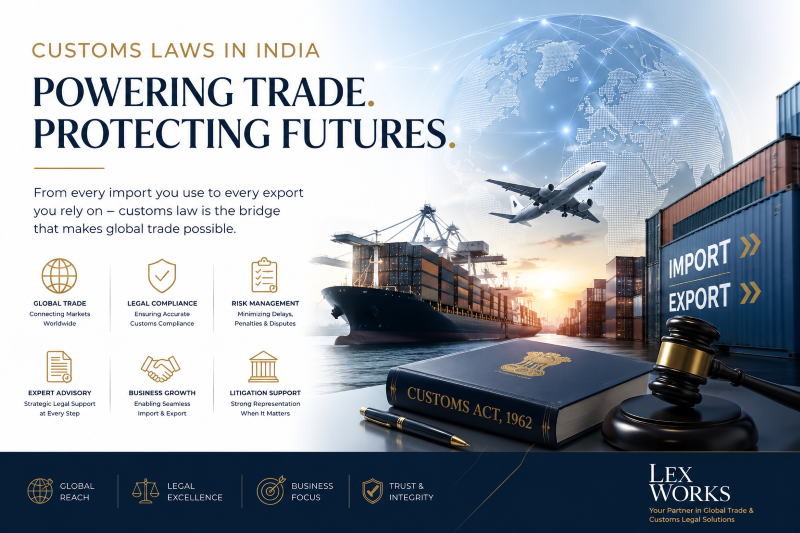
Customs Law in India is primarily governed by the Customs Act, 1962, and the Customs Tariff Act, 1975, along with rules, notifications, and circulars issued by the Central Board of Indirect Taxes and Customs (CBIC).
This body of law regulates:
- The import and export of goods across Indian borders;
- The assessment and levy of customs duties on imported goods;
- The classification of goods under the Harmonized System of Nomenclature (HSN);
- The valuation of goods for the purpose of calculating customs duty;
- The enforcement of prohibitions and restrictions on certain categories of goods;
- Anti-Dumping Duties imposed to protect domestic industries from unfairly priced foreign goods; and
- Clearance procedures involving shipping, freight documentation, and logistics compliance.
The Customs Act, 1962, along with the Customs Tariff Act, allied Rules, Notifications, Circulars, and Foreign Trade Policy regulations, governs the import and export mechanism in India.
Customs law is not merely concerned with the collection of duties; rather, it serves multiple national and commercial objectives such as:
- Regulation of international trade,
- Protection of domestic industries,
- Prevention of smuggling and illegal imports,
- Enforcement of anti-dumping duties,
- Monitoring valuation and classification of goods,
- Ensuring compliance with international trade obligations, and
- Facilitating legitimate trade through procedural frameworks.
With the current growth, customs compliance has become increasingly complex. Businesses today are expected to understand tariff schedules, valuation mechanisms, import restrictions, licensing requirements, exemptions, anti-dumping notifications, country-of-origin rules, and documentary compliance.
For many businesses, especially small and medium enterprises, these legal complexities often become difficult to manage internally.
For any business engaged in cross-border trade whether a first-time small importer or a large multinational corporation compliance with Customs Law is not optional. It is a legal obligation, and violations even inadvertent ones can result in seizure of goods, heavy financial penalties, and protracted litigation
Import & Export Are No Longer Limited to Multinational Corporations
There was a time when international trade was dominated primarily by large multinational corporations. Today, even small businesses, start-ups, online sellers, and regional manufacturers participate in import and export activities.
A small trader may import electronic accessories from China, machinery from Germany, or chemicals from Korea. Similarly, Indian businesses regularly export goods to countries in the Middle East, Europe, Africa, and Central Asia.
However, unlike domestic trade, international transactions involve several regulatory touch points such as:
- Customs authorities,
- Directorate General of Foreign Trade (DGFT),
- Port authorities,
- Shipping lines,
- Freight forwarders,
- Customs brokers,
- Warehousing authorities,
- Banking and foreign exchange regulations,
- Anti-dumping and safeguard duties.
As a result, businesses often encounter legal and procedural complications even before the goods physically arrive in India.
Example: A firm whether a small proprietorship or a multinational subsidiary imports audio speakers from a manufacturer in China into India. After importation, the firm intends to re-export these speakers to a buyer in Uzbekistan.
On paper, this appears to be a straightforward commercial transaction. In practice, however, it involves navigating a series of legal and regulatory challenges that can make or break the business which includes:
- Under which tariff heading the speakers should be classified?
- Whether the goods qualify as complete speakers, components, or audio equipment parts?
- What is the applicable customs duty?
- Whether anti-dumping duties apply?
- Whether BIS certification is mandatory?
- Whether preferential duty benefits are available?
- Whether valuation declared in the invoice is acceptable?
- Whether freight and insurance components are properly included?
- Whether export incentives are available upon re-export?
A mistake at any stage can trigger investigations, detention of goods, or lengthy litigation.
Where Businesses Need Legal Assistance in Customs Matters
Many businesses approach international trade with the assumption that the legal dimension is largely administrative a matter of filing the right forms, paying the right duties, and moving on. This assumption is both common and costly.
The reality is that Customs Law intersects with shipping law, logistics contracts, freight documentation, foreign trade policy, anti-dumping regulations, and GST, creating a web of compliance obligations that requires continuous attention and expert interpretation. A single misstep in any one of these areas can trigger a chain of consequences: financial penalties, delayed shipments, detained goods, and in serious cases, criminal proceedings.
One of the most common misconceptions among importers and exporters is that customs matters are purely operational or accounting issues. In reality, customs disputes are deeply legal in nature; Businesses frequently require legal assistance in several key customs-related matters:
1. Mis-Declaration of Goods
Mis-declaration occurs when the description, quantity, or value of imported or exported goods is incorrectly declared before Customs. This may result from clerical errors, incorrect product descriptions, or deliberate misclassification to reduce duty liability. Under the Customs Act, 1962, mis-declaration is treated as a penal offence and can lead to detention of goods, Show Cause Notices, penalties, and investigations by customs authorities, including the Directorate of Revenue Intelligence (DRI).
2. Under-Valuation of Goods
Customs duty is levied on the transaction value of imported goods. However, Customs authorities may reject the declared value if it appears lower than the actual market value. Such disputes commonly arise in related-party transactions between foreign parent companies and Indian subsidiaries. The Customs Valuation Rules, 2007 prescribe methods for determining assessable value, often requiring detailed legal and documentary support.
3. Tariff Classification Disputes
Correct classification of goods under the Customs Tariff is essential for determining applicable duty rates. Disputes arise when Customs disagrees with the importer’s classification and proposes a higher-duty category. These matters involve interpretation of tariff schedules, Harmonized System (HSN) notes, exemption notifications, and judicial precedents. Even minor differences in classification can significantly impact duty liability.
4. Show Cause Notices and Orders-in-Original
Before demanding additional duty or imposing penalties, Customs authorities issue a Show Cause Notice (SCN) outlining the alleged violations. Importers and exporters are entitled to file replies, submit evidence, and appear for hearings. The adjudicating authority then passes an Order-in-Original (OIO), which may be challenged before appellate forums including Customs Excise and Service Tax Appellate Tribunal, High Courts, and the Supreme Court. Proper legal representation is critical at every stage.
5. Anti-Dumping Duty
Anti-Dumping Duty (ADD) is imposed on imported goods sold below fair market value if such imports harm domestic industries. Applicability depends on tariff classification, country of origin, and product specifications. Businesses may also participate in investigations before the Directorate General of Trade Remedies to challenge or seek review of such duties.
6. Shipping, Freight, and Logistics Compliance
International trade requires extensive documentation, including Bills of Lading, Commercial Invoices, Packing Lists, Certificates of Origin, and Insurance Certificates. Errors or inconsistencies in these documents can delay clearance, deny Free Trade Agreement (FTA) benefits, or lead to penalties. Proper compliance is particularly important for export incentives, re-export transactions, and preferential duty claims..
Why You Need a Legal Team Specializing in Customs Law
For Small Businesses: The cost of a legal mistake in international trade far exceeds the cost of legal advice. A single Show Cause Notice, if not properly responded to, can result in a duty demand plus penalty plus interest that is several times the value of the original shipment. A qualified legal team can help small businesses classify their goods correctly from the outset, structure their import transactions in a legally defensible manner, respond effectively to customs queries and notices, and represent them in appeals if an adverse order is passed.
A customs legal expert helps small businesses by:
- Advising on correct tariff classification,
- Reviewing import documentation,
- Identifying certification requirements,
- Avoiding procedural defects,
- Reducing detention risks,
- Preventing costly penalties.
For small businesses operating on limited margins, avoiding a single customs dispute may save substantial operational losses.
For Multinational Companies : The complexity of cross-border trade for large corporations involving multiple product lines, related-party transactions, transfer pricing considerations, and compliance across several regulatory frameworks simultaneously demands a legal team that is not only knowledgeable but also strategically sophisticated. Expert legal counsel can help multinationals develop robust compliance frameworks, obtain advance rulings on classification and valuation questions, manage DRI investigations, and ensure that their global supply chain strategies are consistent with Indian Customs Law.
Even large corporations with internal compliance departments regularly face:
- Complex classification disputes,
- Cross-border valuation scrutiny,
- Multi-jurisdictional compliance obligations,
- Transfer pricing overlap,
- Investigations involving huge duty exposure,
- Litigation before appellate forums.
External customs counsel provides specialized litigation strategy, independent legal analysis, and representation before customs authorities, tribunals, and constitutional courts.
In both cases, the legal team serves not merely as a reactive firefighter responding to notices and appeals but as a proactive partner that helps businesses navigate the complexities of international trade before problems arise.
Conclusion
Import and Export activities today form the backbone of modern commerce and industrial growth. Whether it is a multinational corporation importing machinery or a small trader sourcing consumer goods internationally, customs compliance has become an unavoidable and highly technical aspect of business operations.In the modern trade environment, customs law is not merely a procedural requirement it is a strategic legal function. Businesses that fail to understand classification, valuation, certification, and compliance requirements often find themselves exposed to litigation, penalties, and operational disruptions.
Whether it involves tariff classification, valuation, anti-dumping duties, documentation, certification, or litigation, customs law demands specialized legal understanding that goes beyond ordinary business operations.
A proactive legal approach not only protects businesses from penalties and investigations but also ensures smoother trade operations, regulatory certainty, and long-term commercial stability. In modern international commerce, having an experienced customs legal team is no longer a luxury it is an operational necessity.