Opening a Poker Club in India: The Licensing Maze and Compliance Architecture
Introduction
The discourse surrounding poker law in India has, for years, remained confined to a singular question. Whether poker constitutes a game of skill or a game of chance. While this debate undoubtedly forms the foundation of the legal analysis, it does little to assist entrepreneurs, investors, hospitality operators, and gaming businesses seeking to establish and operate a poker club within a legally sustainable framework.
In practice, the legality of poker alone does not determine the viability of a poker establishment. Regulatory authorities seldom assess a poker club through the narrow lens of gaming jurisprudence. Instead, they examine the business holistically—its licensing framework, financial controls, municipal permissions, tax compliance, membership structure, security protocols, and adherence to local laws.
Consequently, the modern regulatory challenge is no longer limited to defending poker as a game of skill; it lies in constructing a legally compliant operational ecosystem capable of withstanding regulatory scrutiny from multiple authorities simultaneously.
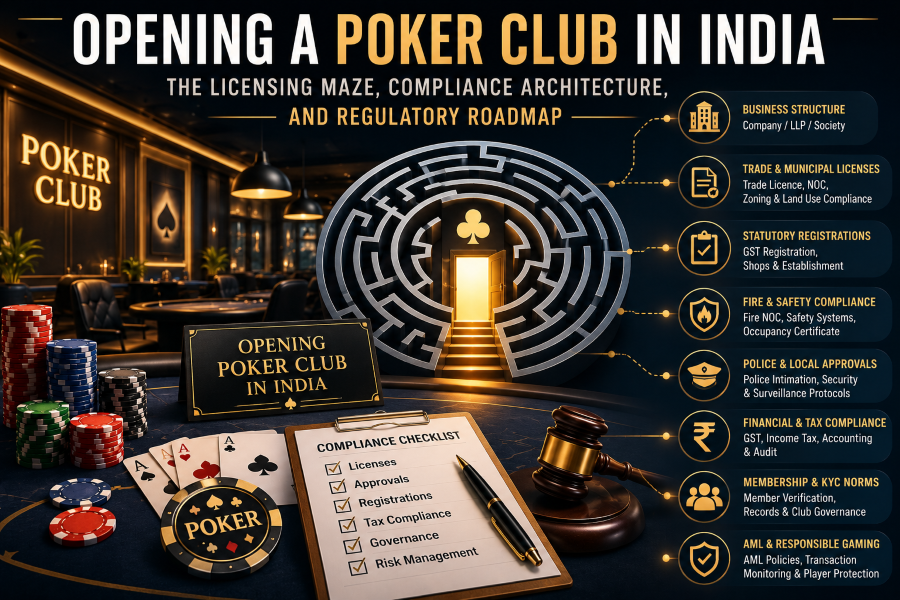
This article seeks to examine the often-overlooked legal architecture governing poker clubs in India, the licences and approvals commonly required, the state-specific regulatory landscape, and the compliance mechanisms that every serious operator should implement before the first tournament is ever hosted.
Understanding the Regulatory Character of a Poker Club
Before considering licences or approvals, one must first address a more fundamental question:
What is a poker club in the eyes of the law?
Depending upon the structure adopted by the operator and the approach of local authorities, a poker establishment may be viewed as:
- A members-only recreational club;
- A commercial entertainment venue;
- A hospitality and leisure establishment;
- A gaming facility;
- A social association; or
- In adverse circumstances, a "common gaming house" under applicable gaming legislation.
The legal classification ultimately influences the nature of regulatory oversight, licensing obligations, and enforcement exposure.
Many operators make the mistake of assuming that incorporation of a company and execution of a membership model are sufficient safeguards. In reality, regulatory authorities increasingly evaluate the substance of operations rather than the terminology employed in internal documentation.
The Foundational Regulatory Framework
A professionally managed poker club generally requires compliance across multiple legal disciplines, each operating independently of gaming laws.
1. Appropriate Business Structure
The first strategic decision concerns the legal vehicle through which operations will be conducted.
Common structures include:
- Private Limited Company;
- Limited Liability Partnership (LLP);
- Registered Society;
- Section 8 Organisation (for non-commercial club structures in limited circumstances).
The choice of structure impacts:
- Capital infusion;
- Investor participation;
- Governance standards;
- Tax treatment;
- Regulatory perception; and
- Liability exposure of promoters.
For commercial poker operations, a Private Limited Company generally offers the most robust governance framework and regulatory credibility.
2. Trade Licence and Local Municipal Permissions
Irrespective of whether poker is considered a skill-based activity, the physical premises must be authorised for commercial operations.
Municipal authorities typically assess:
- Nature of business activity;
- Occupancy classification;
- Local zoning restrictions;
- Building use permissions;
- Public access considerations; and
- Compliance with municipal bye-laws.
A legally defensible poker club cannot operate from premises that are themselves non-compliant with local municipal regulations.
In many enforcement actions across India, proceedings have originated from building-use violations rather than gaming-related concerns.
3. Land Use and Zoning Compliance
This aspect is frequently underestimated.
Before investing substantial resources into infrastructure and branding, operators should verify:
- Whether the premises are located within a commercial zone;
- Whether recreational activities are permitted at the site;
- Whether the occupancy certificate permits such usage;
- Whether local development regulations impose restrictions on assembly-based businesses; and
- Whether parking and public access requirements have been satisfied.
Failure at this stage can jeopardise the entire business model regardless of the legal status of poker itself.
4. Registration under Shops and Establishments Laws
Every poker club employing staff and conducting regular commercial activities must comply with the relevant State Shops and Establishments legislation.
This includes obligations relating to:
- Employee records;
- Working hours;
- Wage registers;
- Leave entitlements;
- Weekly off requirements;
- Workplace safety norms.
As regulatory enforcement becomes increasingly digitised, labour compliance has emerged as an important component of operational due diligence.
The Emerging Importance of Financial Compliance
Historically, gaming regulation focused primarily on the nature of the activity being conducted.
Today, enforcement agencies increasingly focus on the movement of money.
This shift has profound implications for poker operators.
GST Considerations
Poker clubs frequently generate revenue through multiple streams, including:
- Membership fees;
- Annual subscriptions;
- Tournament entry fees;
- Service charges;
- Food and beverage sales;
- Event sponsorships.
Each revenue stream may attract distinct tax considerations.
Given the evolving GST jurisprudence concerning gaming-related activities, operators must adopt carefully structured accounting and invoicing practices from inception rather than attempting retrospective compliance.
Banking and Fund Management Controls
A professionally managed poker establishment should implement robust financial governance mechanisms, including:
- Dedicated business banking channels;
- Audit-ready accounting systems;
- Segregation of operational and tournament funds;
- Cash-handling protocols;
- Periodic financial audits.
Regulators increasingly associate transparency of financial records with legitimacy of operations.
Poor record-keeping often creates greater regulatory risk than the gaming activity itself.
Membership Structures: More Than a Formality
Many poker clubs operate through membership-based models.
However, membership should not be viewed as a mere procedural formality.
A credible membership framework generally includes:
Admission Protocols
- Identity verification;
- Age verification;
- Membership approval process;
- Maintenance of membership records.
Governance Protocols
- Club rules and regulations;
- Code of conduct;
- Disciplinary procedures;
- Membership termination provisions.
Record Maintenance
- Digital member databases;
- Entry logs;
- Tournament participation records;
- Financial transaction records.
The absence of a genuine membership structure often becomes a focal point during regulatory inspections.
Surveillance, Security, and Operational Controls
As poker clubs mature into organised businesses, operational transparency has become a key regulatory expectation.
Best practices increasingly include:
Surveillance Systems
- Comprehensive CCTV coverage;
- Secure video retention policies;
- Monitoring of gaming areas;
- Access-control mechanisms.
Security Protocols
- Visitor management systems;
- Restricted access areas;
- Incident reporting mechanisms;
- Cash movement safeguards.
Internal Compliance Manuals
- Anti-cheating protocols;
- Tournament governance procedures;
- Responsible gaming policies;
- Internal audit mechanisms.
Such measures not only strengthen regulatory defensibility but also enhance credibility among players and investors.
Conclusion
The future of poker regulation in India is unlikely to be shaped solely by judicial pronouncements on the skill-versus-chance debate. Regulatory attention is increasingly shifting towards governance, accountability, financial transparency, and operational integrity.
For entrepreneurs contemplating entry into this sector, the critical question is no longer whether poker can be legally played. The more important question is whether the club itself has been structured to withstand scrutiny from municipal authorities, taxation departments, law enforcement agencies, labour regulators, and gaming authorities alike.
In today's regulatory environment, the strongest defence is not merely a favourable legal opinion on poker. It is a meticulously designed compliance framework capable of demonstrating legitimacy at every stage of operation.
A poker club may begin with a deck of cards, but its long-term survival depends upon the strength of its regulatory foundation.