Supreme Court on Front-of-Pack Labelling: A Supervisory Roadmap for Consumer Health and Clear Packaging
3S and Our Health Society v. Union of India & Anr.
2026 INSC 988 | M.A. No. 1177 of 2025 in W.P. (C) No. 437 of 2024
The Supreme Court’s order of 10 September 2026 on Front-of-Pack Labelling (FoPL) is not a final judgment and does not notify a regulation. It is a supervisory order in a continuing public-interest matter. That distinction matters for lawyers, food businesses and consumers.
What the Court has done is more durable than a one-line direction to print a logo. It has fixed the constitutional standard against which any future FoPL regime will be tested, recorded the latest proposal of the Food Safety and Standards Authority of India (FSSAI), identified the gaps in that proposal, and required those gaps to be answered on affidavit before the next hearing on 28 September 2026.
For consumer health, and for clear knowledge on the pack, the path is already visible even though the printed hexagon is not yet frozen.
Why this interlocutory order still matters
The parent case is Writ Petition (Civil) No. 437 of 2024. The present order arises from Miscellaneous Application No. 1177 of 2025.
On 13 August 2026 the Court had already held that urgent headway on FoPL was required; that inspiration may be drawn from international packaging standards; and that the link between obesity, diabetes, heart disease, hypertension and foods high in fat, sugar or salt (HFSS) or ultra-processed foods (UPF) was scientifically substantiated. Two weeks were granted to place a “final decision” on record. The Union was told that if it did not act on its own, the Court would pass further directions.
FSSAI’s affidavit of 28 August 2026 was the response. The September order examines that affidavit. The Court accepts “significant progress” and then holds that several aspects of practical implementation remain ambiguous. The thirteen questions that follow are not rhetoric. They are the Court’s method of converting a policy note into a record that can later support either a robust regulation or further mandatory directions.
The governing sentence from the August order still controls the case:
“If the Union does it on its own, well and good, otherwise we shall proceed to pass further directions.”
This is continuing mandamus in a field that is expert-led, constitutionally duty-bound and commercially sensitive.
The constitutional standard already fixed
The Court has not invented a new right. It has applied two provisions already underlined in the August order.
Article 21. The right to life includes the right to health. That right casts a duty on the State not only to refrain from impairing health but also to take affirmative steps to protect it. FoPL is treated as one such step: a design intervention that enables informed choice at the point of purchase and, over time, product reformulation.
Article 47. Improvement of public health is a primary duty of the State. Labelling is not a favour to the literate urban buyer. It is part of the duty to improve the food environment, “more particularly” for growing children.
Two further notes run through the order. First, the Court did not accept the stance that India cannot match international standards, particularly those of developed countries. The question put to the Union was whether India should remain an “underdeveloped country” in protecting citizens’ health. Second, FoPL was already in the Union’s notice through suggestions in the Economic Survey. Delay cannot be defended as want of notice.
Once FoPL is anchored in Articles 21 and 47, a proposal that is scientifically thin, visually weak, postponed without a calendar, or left to industry discretion is not a mere policy disagreement. It is a potential shortfall in a constitutional duty.
What FSSAI placed on record
FSSAI proposed a warning-style FoPL, not a star rating or a Nutrient Reference Value (NRV) panel as the primary signal. The core features were as follows:
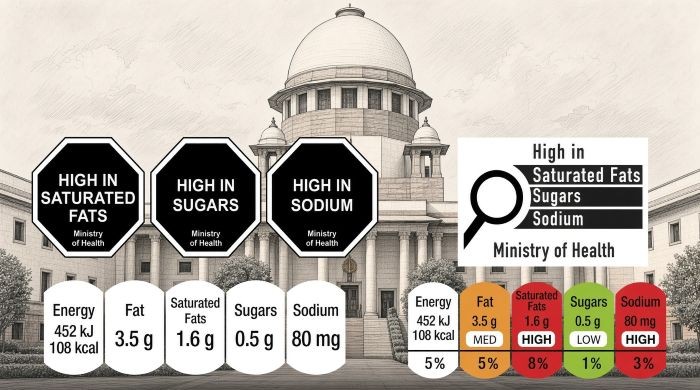
- A prominent red hexagonal warning on the front of pack for products high in any two or more of added saturated fat, added sugar and salt, using thresholds in the ICMR-NIN Dietary Guidelines for Indians, 2024.
- Text such as “HIGH FAT”, “HIGH SUGAR”, “HIGH SALT” and/or “HIGHLY SWEETENED BEVERAGE”.
- Font one point larger than the back-of-pack nutrition table.
- Exemptions for single-ingredient foods and for foods inherently rich in fat, sugar or salt, such as ghee, edible oil, salt, sugar, jaggery and honey.
- Phased implementation: Phase I for products high in two or more specified nutrients and specified sweetened beverages; Phase II for products high in any one nutrient.
- Notification by amendment of existing regulations after the prescribed procedure.
The Court did not discard this architecture. It treated the red hexagon as a starting point. The difficulty was that a starting point had been presented as if it were already a complete regime.
The path the Court has given: standards for a workable FoPL.
1. Scientific coherence, not a narrowed definition of harm
The petitioner’s objection was that a “two or more nutrients” trigger redefines HFSS. Excess sugar, excess salt and excess saturated fat are independently harmful and act through different pathways: metabolic disease and diabetes; hypertension; and cardiovascular disease. Requiring two nutrients at once narrows Phase I coverage without a clear scientific basis.
Official texts themselves are not aligned. The 2024 Dietary Guidelines describe HFSS foods in language that mixes “or” and “and”. The 2022 Draft Labelling Amendment Regulations defined HFSS as a processed food with high levels of saturated fat or total sugar or sodium. That movement between “and” and “or” decides how many products will carry a warning in the first years of the regime.
The Court also examined Tables 15.1 and 15.2 of the 2024 Guidelines. Table 15.1 states numeric thresholds per 100 g or ml. Table 15.2 classifies foods by processing (Groups A, B and C) and by calorie band (categories 1, 2 and 3). Categories 2 and 3 are HFSS. Group C is identified with ultra-processed foods. Yet categories 2 and 3 are not given clear, separate nutrient amounts. If FSSAI simply applies Table 15.1, the distinction between “more harmful” and “still high but less extreme” disappears.
The Court asked whether that distinction — and the distinction between moderately processed and ultra-processed foods — will be reflected on the label. It saw prima facie logic in an Israel-style path: begin with higher thresholds, or with the most extreme category, and tighten them over a defined period. A bar that is too low may stamp almost every pack with the same warning and deny the consumer a healthier relative choice. A bar that is too high may leave the most widely sold packaged foods untouched.
2. Time is a legal ingredient, not a courtesy to industry
A phase without a date is not a phase. It is an option. The Court said that “consumer acceptability” and time for reformulation cannot justify an open-ended gap between Phase I and Phase II. A reasonable, scientifically justified and clearly defined transition is part of a workable approach.
The same concern appears on mandatory force. The 2022 draft Indian Nutrition Rating scheme had contemplated 48 months of voluntary observance. The petitioner asked that the final FoPL be mandatory from day one. The Court did not decide that issue. It required FSSAI to take a position and, if a breathing period is proposed, to justify its length.
3. Prominence is a legal test, not a design preference
Regulation 4(7) of the Food Safety and Standards (Labelling and Display) Regulations, 2020 already requires label contents to be clear, unambiguous, prominent, conspicuous, indelible and readily legible under normal conditions of purchase and use. Regulation 6 fixes minimum letter heights by area of the principal display panel.
FSSAI’s only metric was “one point larger” than the back-of-pack table. The Court held that this is not enough. Dimensions of the hexagon, whether size is fixed or proportional to pack area, font in relation to the hexagon, contrast background, and placement comparable to the veg/non-veg symbol rules are all part of the legal question whether a warning will actually be seen.
The petitioner pointed to countries where warning labels occupy about 15 to 20 per cent of the principal panel. The Court did not adopt that figure as a mandate. It directed the expert committee to deliberate on relative size. The principle is what matters: a warning that exists only as fine print fails the 2020 Regulations and, behind them, the Article 21 purpose of informed choice.
4. The pack must speak to literacy, language and digital purchase
A word-heavy warning presupposes a level of comprehension that India does not uniformly possess. The Court noted diversity of States, vernaculars, age groups and literacy levels, and the growing digital mode of purchase. An inclusive FoPL should combine words with pictorial representations of fat, sugar and salt. Separate hexagons for each nutrient would make that combination easier and would allow a shopper to see, even from a distance, whether a product is high in one nutrient or several.
Colour was put in the same basket. Indian consumers already link green with vegetarian products and red with non-vegetarian symbols. A red hexagon may confuse rather than warn. The Court did not ban red. It required thought. The standard is communicative effectiveness, not aesthetic loyalty to the warning-red used elsewhere.
5. Total burden on the body, not only what was “added” in the factory
The Court described sugar, salt and fat as the “unholy trinity” and observed that the harm arises from the total value in the product, not only from added sugar or added fat. Minutes of the stakeholders’ meeting of 29 October 2021 had recorded consensus on total sugar for FoPL, and on saturated fat rather than total fat, with a separate concern about dairy. The present proposal appeared to revert to “added” sugar and “added” fat. The Court asked whether the stance had changed and how the underlying concerns would be met. Trans fat was expressly brought into the inquiry.
These are not drafting quibbles. They decide whether a juice, a dairy sweet or a product with naturally present sugars can carry a clean front of pack while still delivering a metabolic load.
6. Reformulation must not become a flight into other chemicals
Salt, sugar and fat perform functional roles: taste, texture, shelf life, microbiological safety and processing stability. A warning aimed only at those three nutrients may increase the use of artificial preservatives, emulsifiers and other additives. The Court treated that risk as a regulatory problem. FSSAI must anticipate it both in setting thresholds and in framing corresponding controls. A label that drives one harm down and another harm up would be a pyrrhic public-health victory.
7. Warning first; data second
The All India Food Processors Association preferred an NRV, per-serving approach used in some Western markets. The Court did not deny that such data can help a careful reader. It held, however, that data alone often becomes a red herring: noticed by few, ignored by most. A FoPL that raises caution about the total content of nutrients of concern is, in the Court’s present view, the more appropriate primary model. Numbers on the back of the pack can coexist with a front-of-pack signal. They cannot replace it.
8. Children and school literacy are part of the same duty
The Court returned to UNICEF’s Child Nutrition Report 2025: overweight among children and adolescents aged 5 to 19 rose from 2 per cent to 10 per cent between 2000 and 2022. Most food inside schools may be freshly cooked; most food in the school’s vicinity is packaged. Exposure shapes preference. Labelling on the pack is incomplete unless schools teach children how to read a nutrition table and a warning hexagon. That question is addressed to the Union, not only to FSSAI, because curriculum lies beyond the food regulator.
The thirteen queries as a consumer-health checklist
The questions look technical. Their common object is that the eventual pack should give the ordinary buyer clear knowledge of what is being purchased, and that the State should be able to defend the regime as a genuine health measure.
Time and enforceability. What fixed timeline separates Phase I from Phase II? Once regulations are notified, will compliance be mandatory at once, or only after a voluntary period, and of what length?
Trigger and coverage. What is the basis for starting with products high in two or more nutrients, and specified sweetened beverages, before covering products high in any one nutrient? How will those beverages be identified, and on what thresholds?
Scientific architecture. Will the FoPL distinguish calorie categories 2 and 3 in the 2024 Guidelines? Will moderately processed Group B foods be treated differently from ultra-processed Group C foods? Will thresholds use total sugar and saturated fat, as indicated in the 2021 stakeholders’ meeting? How will trans fat be factored in?
Visibility and design. Should red be revisited because consumers associate it with non-veg symbols? What are the dimensions of the hexagon? Will size be fixed or proportional to the pack? How will font relate to the hexagon, and where will it be placed? Without pictograms, how will the label reach varied literacy levels? Why one composite hexagon instead of a separate hexagon for each nutrient?
Secondary harms. How will FSSAI regulate a possible rise in preservatives, emulsifiers and other additives if salt, sugar and fat are driven down?
Literacy beyond the pack. How will the Union build, through curriculum, workshops and school initiatives, the ability to interpret nutrition information and FoPL?
A regulation that answers these questions with precision will be difficult to call window dressing. A regulation that leaves them unanswered will be difficult to defend as compliance with the August and September orders.
What the Supreme Court has not decided
Accuracy requires a short list of what this order does not do.
- It has not notified a FoPL regulation. FSSAI must still follow the statutory amendment procedure.
- It has not frozen the red hexagon, the colour red, the two-phase structure, or the 2024 Guideline numbers as the last word.
- It has not adopted the Israeli model. It has only said there is prima facie logic in staged tightening of thresholds.
- It has not held that FoPL must be mandatory from day one. It has required a reasoned choice.
- It has not written school curriculum. It has required the Union to explain how nutritional literacy will enter the classroom.
- It has not decided the writ petition. FSSAI has ten days from 10 September 2026 to file its affidavit. The petitioner will reply. The matter is listed on 28 September 2026.
The restraint is itself a standard. The Court is keeping the expert body in the foreground while refusing to accept expertise as a shield for vagueness.
Implications for the regulator, industry and the consumer
For FSSAI and the Union. The next affidavit is not a repetition of policy intent. It must supply a calendar, a definitional choice between conjunctive and disjunctive HFSS, a position on total versus added nutrients, a specification of size and placement that can be tested against Regulation 4(7), a literacy-sensitive design, and a plan for additive substitution and school education. Silence on any of these will invite further directions.
For food business operators. Reformulation time is being treated as legitimate only if it is bounded. Exemptions for single-ingredient and inherently rich foods will not shelter formulated packaged products that sit above nutrient-of-concern thresholds. Industry’s preference for per-serving NRV panels has been heard and, for the moment, subordinated to a warning model. Businesses that begin work against the 2024 Guideline numbers, while watching the Court’s questions on total sugar, saturated fat and ultra-processed classification, will be better placed than those waiting for a perfectly settled gazette notification.
For consumers and public-health advocates. The right being litigated is not a right to a particular logo. It is a right to information that is actually usable: large enough to see, simple enough to grasp without specialised literacy, accurate enough to reflect total nutritional burden, and early enough in the shopping journey to change a choice. The next FSSAI affidavit should be measured against that test, not against the mere fact that a hexagon has been proposed.
The direction of travel
If one sentence had to capture the path the Court has given, it would be this. India may choose its own visual grammar of warning, but it may not choose opacity, delay without a clock, or a definition of “high” that leaves the most widely consumed packaged foods untouched while claiming to protect children.
The September order therefore functions as a design brief issued under constitutional supervision. The brief has four commands.
First, define harm in a way that science and the 2024 Guidelines can support, and resolve the and/or confusion before phases are built on it.
Second, make the warning visible and inclusive: size, placement, pictogram and, if needed, separate signals for each nutrient.
Third, bind the regime to time and to mandatory force after a justified interval, if any.
Fourth, treat the pack and the school as one environment, so that a child who sees a hexagon also knows what it means.
None of this is the last chapter. It is the chapter in which the Court refused to let FoPL remain a press note. For a country negotiating undernutrition and a steep rise in diet-related disease at the same time, that refusal is itself a legal event. The quality of the next affidavit will decide whether the event matures into a regulation that ordinary buyers can use, or into another round of directions from the same Bench on 28 September 2026.
Disclaimer
This commentary is based on the reportable order dated 10 September 2026 in 3S and Our Health Society v. Union of India & Anr., 2026 INSC 988, read with the earlier order dated 13 August 2026 in the same proceedings. It is not a prediction of the final form of the FoPL regulation and is not legal advice on compliance for any particular product. Until FSSAI answers the Court’s questions and a regulation is notified, the path is clear even if the printed hexagon is not.