Why WhatsApp Notices Fail in Court: Section 63(4)(c) BSA Certificate & Section 35 BNSS After the 2025–26 Rulings
A practitioner’s guide to Section 63(4)(c) of the Bharatiya Sakshya Adhiniyam and electronic service under Section 35 BNSS, updated with the Delhi High Court decision in Punjab Gasket Industries v. Murtaza Ali (2026) and the Supreme Court’s 2025 ruling in Satender Kumar Antil v. CBI.
Short summary: Indian courts have consistently held that a WhatsApp message, email trail or screenshot is not, by itself, legal compliance. Two recent decisions reinforce this position: the Delhi High Court’s ruling in Punjab Gasket Industries v. Murtaza Ali (2026) on the electronic evidence certificate under Section 63(4)(c) BSA, and the Supreme Court’s decision in Satender Kumar Antil v. CBI (2025 INSC 909) holding that notices under Section 35 BNSS cannot be served through WhatsApp or email. This article examines both rulings and sets out the practical compliance requirements for 2026.
Introduction
The legal system continues to adapt to digital communication. Contracts are negotiated by email, settlements are discussed on WhatsApp, and notices are frequently forwarded electronically. Many litigants treat such digital exchanges as sufficient legal compliance.
This assumption is incorrect. Technology has changed the medium of communication; it has not altered the legal standards governing proof, authentication and service.
Digital Records Require Statutory Authentication
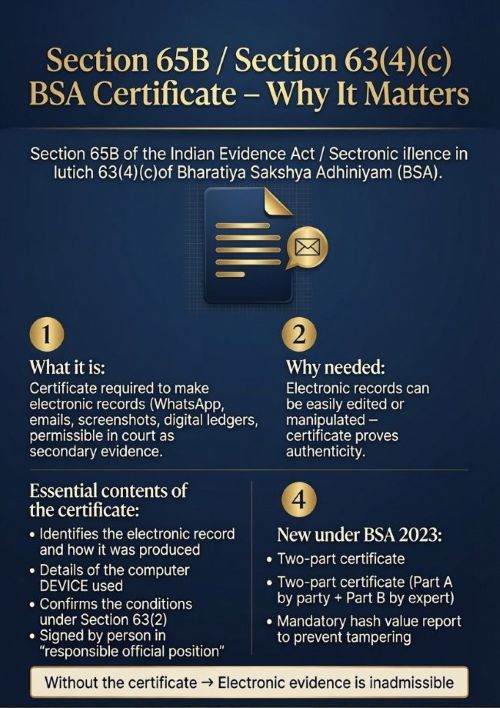
Electronic records can be modified, deleted or manipulated without leaving a visible trace. Recognising this vulnerability, the legislature enacted a dedicated evidentiary mechanism. Section 65B of the Indian Evidence Act, 1872, has now been substantially re-enacted in Section 63 of the Bharatiya Sakshya Adhiniyam, 2023 (BSA), which has been in force since 1 July 2024. The certificate requirement is contained in Section 63(4)(c).
Under the earlier regime, Section 65B(4) required a certificate that:
- identified the electronic record and described how it was produced;
- gave particulars of the device;
- addressed the conditions in sub-section (2); and
- was signed by a person occupying a responsible official position in relation to the operation of the device or the management of the relevant activities.
The BSA has retained the core requirement while introducing two notable changes:
- The certificate is now in two parts — Part A to be filled by the party relying on the record and Part B by the expert referred to in Section 39 BSA.
- A hash value report of the electronic record must accompany the certificate.
Electronic records remain admissible as secondary evidence only if properly certified. Primary evidence requires production of the original device itself.
The Certificate Is Foundational, Not Technical
Where a party relies on WhatsApp chats, emails, screenshots, computer-generated ledgers or digital invoices, the certificate under Section 63(4)(c) is the legal foundation of authenticity. Without it, even genuine electronic material can be rendered inadmissible.
Judicial Development
The interpretation of the certificate requirement has evolved through a series of decisions:
- State (NCT of Delhi) v. Navjot Sandhu initially permitted electronic evidence to be admitted under the general provisions governing documentary evidence.
- Anvar P.V. v. P.K. Basheer (2014) overruled that approach and held that the conditions of Section 65B are mandatory for secondary electronic evidence.
- Arjun Panditrao Khotkar v. Kailash Kushanrao Gorantyal (2020) reaffirmed the mandatory character of the certificate while clarifying that the owner or operator of the device may prove the original by entering the witness box, in which case no certificate is required.
- Subsequent decisions in State of Karnataka v. T. Naseer (2023) and Mohd. Arif v. State (NCT of Delhi) (2023) 3 SCC 654 have confirmed that the certificate may be issued by any person occupying a responsible official position in relation to the device or the relevant activity.
Punjab Gasket Industries and Anr. v. Murtaza Ali (Delhi High Court, 2026)
In Punjab Gasket Industries and Anr. v. Murtaza Ali (RFA(COMM) 511/2024, decided on 9 January 2026), the Delhi High Court examined the practical application of the certificate requirement in a commercial recovery suit based on a computer-generated ledger and invoices.
The Trial Court had initially dismissed the suit on the ground that no Section 65B certificate had been filed. On review it was found that the certificate had in fact been on record from the inception of the suit but had been overlooked. The Trial Court corrected the error and decreed the suit. The defendants appealed.
The High Court held:
- Filing the certificate with the pleadings is sufficient. Commercial Courts practice directions require parties to furnish the certificate along with the pleadings. Once the certificate is on record, it need not be formally exhibited through a witness to render the electronic record admissible.
- A sole proprietor who is fully conversant with the business and its records can sign the certificate. The expression “responsible official position” is to be read flexibly and is not confined to the person who physically operated the computer.
- While ledger entries alone cannot fasten liability under Section 34 of the Evidence Act (now reflected in the BSA), the ledger in that case stood corroborated by invoices and oral evidence. The certificate was therefore necessary but not sufficient by itself.
The decision underscores the importance of placing the certificate on record at the earliest stage, ideally with the pleadings.
Contract Formation versus Evidentiary Proof
Indian law recognises digital contracting. Offer and acceptance communicated by email or instant messaging can create a binding contract. Contract formation and evidentiary proof, however, are distinct questions. A commercially valid digital agreement remains vulnerable in court if the electronic record relied upon is not properly authenticated under Section 63(4)(c).
WhatsApp Service under Section 35 BNSS
A common procedural error is the assumption that service via WhatsApp constitutes valid legal service merely because the message shows “delivered” or double blue ticks. Platform-level delivery does not establish statutory compliance, nor does it prove that the intended recipient actually received and understood the notice.
In Satender Kumar Antil v. Central Bureau of Investigation, 2025 INSC 909, the Supreme Court held that electronic communication — whether by WhatsApp, email or any other electronic mode — is not a valid method of serving a notice under Section 35 of the Bharatiya Nagarik Suraksha Sanhita, 2023. The Court dismissed the State of Haryana’s application seeking modification of its earlier directions on this point.
The Court’s reasoning is significant:
- The BNSS expressly permits electronic communication in limited contexts, such as Section 94 (electronic summons to produce a document) and Section 193 (electronic transmission of investigation reports). Parliament therefore turned its mind to electronic modes where it intended to allow them.
- Section 35 contains no such authorisation. The deliberate omission, read against the express provisions elsewhere, indicates legislative intent.
- A notice under Section 35 is distinct from a court-issued summons. Non-compliance can lead to arrest and therefore directly engages Article 21. Service must be reliable enough to establish that the individual actually received the notice — something a WhatsApp delivery tick cannot guarantee given shared devices, changed numbers and uneven connectivity.
- Non-compliance with a Section 35 notice does not automatically result in arrest; the investigating officer retains discretion, and arrest remains a last resort.
Practitioners should not advise or assume that a Section 35 BNSS notice, or any coercive notice whose non-compliance can affect personal liberty, can be validly served by WhatsApp or email unless a specific statutory provision expressly permits it.
Requirements for Valid Electronic Service
Where electronic service is statutorily permitted, it must still satisfy:
- identifiable recipient details;
- a traceable mode of transmission;
- compliance with the specific statutory framework; and
- proof capable of judicial verification.
An informal private WhatsApp exchange cannot substitute for service recognised under procedural law.
Affidavit Verification
Where electronic service is relied upon in a context where it is permitted, an affidavit remains essential. The affidavit should confirm who transmitted the communication, what exact document was sent, when transmission occurred, which electronic address or number was used, and that the annexed record accurately reflects the exchange. A screenshot without supporting affidavit remains an unverified electronic image.
Practical Compliance Checklist for 2026
- Obtain the Section 63(4)(c) BSA certificate (Parts A and B) for every electronic record relied upon, preferably at the time the record is collected or at the latest with the pleadings. Courts examine whether the certificate exists on record.
- Attach the hash value report with the certificate. This is now a mandatory technical safeguard.
- Identify the signatory broadly. Courts have accepted that a proprietor or manager conversant with the relevant activity may sign even if that person did not personally operate the device.
- Do not serve a Section 35 BNSS notice (or any similarly coercive notice affecting liberty) by WhatsApp or email. The Supreme Court has held such service invalid. Only specific provisions such as Sections 94 and 193 BNSS expressly permit electronic modes.
- Support every claim of electronic service with a verification affidavit. A screenshot alone is insufficient.
- Corroborate electronic books of account and invoices with independent evidence. Section 34 continues to bar reliance on book entries alone.
Conclusion
Electronic communication has improved efficiency, but convenience is not compliance. The shift from Section 65B of the Evidence Act to Section 63(4)(c) of the BSA has not diluted the authentication requirement; it has refined it. The Supreme Court’s clear prohibition on electronic service of Section 35 BNSS notices has closed an area of frequent procedural error.
Where electronic evidence is relied upon, the certificate under Section 63(4)(c) together with the hash value report is indispensable. Where service is sought to be effected electronically, it must rest on express statutory authorisation and be supported by proper affidavit verification. Courts decide disputes on admissible proof placed on record in accordance with law, not on assumptions of convenience.
Frequently Asked Questions
Is a Section 65B certificate still required after the Bharatiya Sakshya Adhiniyam, 2023? Yes. The requirement now appears under Section 63(4)(c) of the BSA in a two-part format, accompanied by a hash value report.
Who can sign the Section 63(4)(c) certificate? Any person occupying a responsible official position in relation to the operation of the device or the management of the relevant activity. Courts have read this expression flexibly to include a sole proprietor who is fully conversant with the records.
Can a WhatsApp message serve as a legal notice under Section 35 BNSS? No. The Supreme Court in Satender Kumar Antil (2025 INSC 909) has held that WhatsApp or email service is not valid for notices under Section 35 BNSS. Electronic service is permitted only where the statute expressly authorises it (for example, Sections 94 and 193 BNSS).
Must the Section 63(4)(c) certificate be formally exhibited at trial? The Delhi High Court in Punjab Gasket Industries has held that filing or furnishing the certificate on record (typically with the pleadings) is sufficient. Separate formal exhibition through a witness is not required if the certificate is already on the record.